Stop The Code: Review of the EHRC Guidance
The LGBTQIA+ community need your voice, now
June is 'Pride Month' internationally, and we're asking you to write to your MP
Here's why it matters more than you might think.
On 21 May 2026, the Equality and Human Rights Commission (EHRC) updated Code of Practice was laid before Parliament. This isn't just dry policy language - because what it actually does affects all of us, not just trans people.
We only have until 30th June to stop it.
Quick links: (or read on to find out why this matters and what you can do).
What is the EHRC, and why does this matter?
The EHRC is the body that oversees the Equality Act 2010, the law that protects people from discrimination based on characteristics like sex, disability, race and gender reassignment.
A Code of Practice doesn't change that law, but it tells courts, employers and services how to interpret it day to day - so in practice, it's important.
This particular Code was written in response to last year's Supreme Court ruling in For Women Scotland v The Scottish Ministers, which said "sex" in the Equality Act means "biological sex*" in certain contexts. Parliament has 40 days, until around 30 June, to scrutinise this Code before it takes effect. After that, it shapes how every hospital, gym, refuge, school and public service in the country handles sex and gender, for years to come.
Why this isn't only a trans issue?
The immediate and obvious impact is on trans, non-binary and intersex people.
The Code says services can lawfully exclude trans women from women's spaces and trans men from men's spaces "based on sex", pointing them towards "third" or gender-neutral options instead. That's not equal treatment, it's a second tier of access, and it puts trans people at real risk of harm in places like toilets, changing rooms, refuges and hospital wards.
But look closer and you'll see this guidance asks something of everyone. It tells service providers to weigh up whether other users might "reasonably object" to sharing a space with someone who "appears to be of the opposite sex", and says evidence for that can include how a person looks.
This doesn't make anyone safer.
It just provides justification for fear, prejudice, intolerance and exclusion. A policy that can't reliably tell who it's supposed to protect isn't a safety measure, it's unworkable.
There is no reliable way to tell someone's biological sex by looking at them. Relying on guesswork, the Code will mean staff and strangers making snap judgements about who looks "woman enough" or "man enough" to belong somewhere. That puts cis women under suspicion too, particularly women who are tall, broad shouldered, have visible body hair, or simply don't fit a narrow (often racialised) idea of what a woman should look like. Butch women, disabled women, women of colour and trans women could all be challenged on the same flawed basis.
The human cost
The British Medical Association has called the Code "scientifically illiterate" and "biologically nonsensical".
Mind, Samaritans and the Centre for Mental Health have all warned it poses a serious risk to trans and non-binary people's mental health.
Samaritans saw a 40% rise in crisis calls after last year's Supreme Court ruling alone. This Code risks making that worse.
What you can do right now...
Write to your MP: They have the power to challenge this Code in Parliament before it's too late.
The easiest way to do this is through a ready-made tool. Add your postcode and either of these links will find your MP and load a pre-drafted letter, ready to send in minutes:
Not A Phase's Email Your MP tool
Equal Recognition's Email Your MP tool, built by TransActual, Trans+ Solidarity Alliance and Scottish Trans, which also asks your MP to back EDM 240.
Before you hit send, make it yours:
Check your full name and postal address are in there. MPs only respond to verified constituents.
Share your identity if you want to, a word or two is enough, or leave it out.
Add one sentence about how this affects you.
A name. A friend. A space you've stopped using. Specific gets read. Generic gets filed.
Make sure it's signed off with your real name.
If you'd rather look your MP up directly and write your own personal letter, you can do that via Parliament's Find Your MP page, or you could ask for a face to face meeting at a drop in surgery.
Early Day Motion 240.
Nadia Whittome MP has tabled a motion, EDM 240, to reject the Code outright. It already has cross party support. Ask your MP to back it too.
Join the Mass Lobby.
MPs and politicians will be lobbied directly in Parliament on 25th June. You can sign up through Trans Solidarity Alliance.
Need support?
If any of this is hitting close to home, you don't have to sit with it alone. Mermaids, Galop and Switchboard are there to talk to, alongside your own friends, loved ones and local groups.
*'Biological sex' is the confusing terminology the Supreme Court used, which was intended to reference sex as assigned at birth, regardless of whether a trans person has a Gender Recognition Certificate and has legally changed the sex marker on their birth certificate. The Equalities Act protects trans women under the 'sex' characteristic if they experience discrimination from someone assuming they are a women AND it also protects the characteristic of 'Gender Reassignment' meaning that a person is legally protected from discrimination about changes to their gender. This legal protection applies regardless of whether they have a Gender Recognition Certificate and applies at any stage of their gender transition, regardless of any physical or medical changes.
The EHRC Code undermines these legal protections by prioritising the 'discomfort' of cis gender people.

Other resources to help you with your allyship
Below you'll find a useful webinar and other helpful links.
REPLAY RECORDING
Trans Allyship Now webinar - April 2025
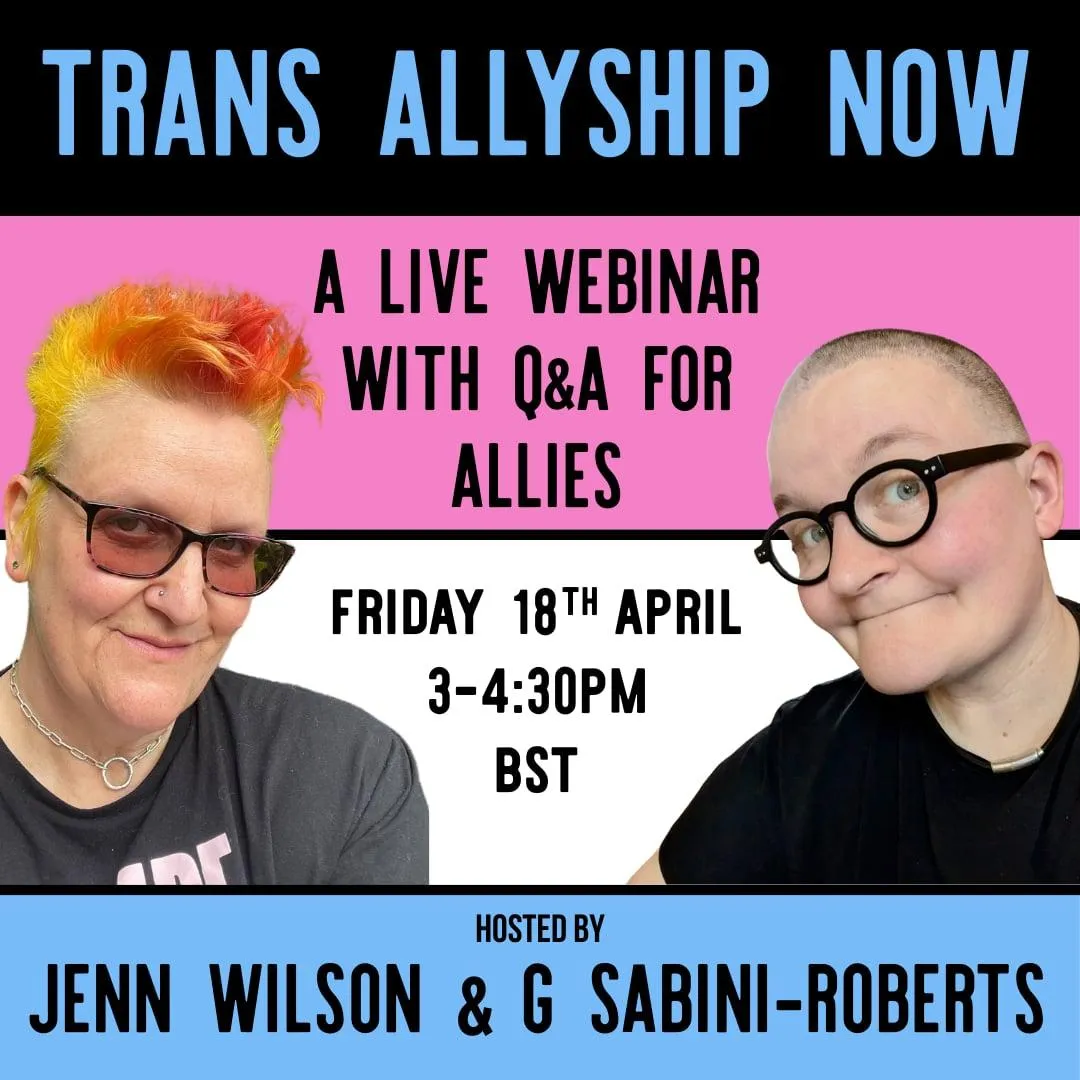
You'll find links and further information for allies below the video.
Hosted by Jenn Wilson and G Sabini-Roberts, this webinar was recorded live on 18th April, two days after the UK Supreme Court ruling on the meaning of "woman" in the Equalities Act 2010.
The session invited anyone of any gender that wishes to support trans and wider LGBTQIA+ community at this time to come for:
> Myth busting and simplified information what the Supreme Court ruling actually said and what that means
> The reasons trans people are concerned and who else is impacted by this ruling
> Suggestions for how to respond as an ally, now and in the near future
> An opportunity to ask questions without fear of judgement or calling out
Here is the replay
ACCESS NOTE: If you have difficulties watching, listening or reading the content provided here please email [email protected] and we will do all we can to provide it in a version that works for you.
Thank you for watching. Please see useful links and contacts below and join the mailing list to stay informed.
Other useful contacts & info
To contact any speakers email: [email protected]
Mentioned in the Zoom chat
*Links correct at time of publication. This webpage is put together by voluntary effort. You can support Jenn Wilson's ongoing work by joining the mailing list below or emailing [email protected]

Join the Irregular mailing list
Everything we do at Irregular Inc Ltd is consent-led, so you get to decide how often you hear from us.
Our E-mailing list provides Irregular news, plus information and services or resources you can buy. You can unsubscribe or change the frequency at any time. We will not share your data.
Authentic Intention
Playful Curiosity
Relentless Kindness
NO to Normal

For a life you love...and the world we all need
Copyright 2026 Irregular Inc